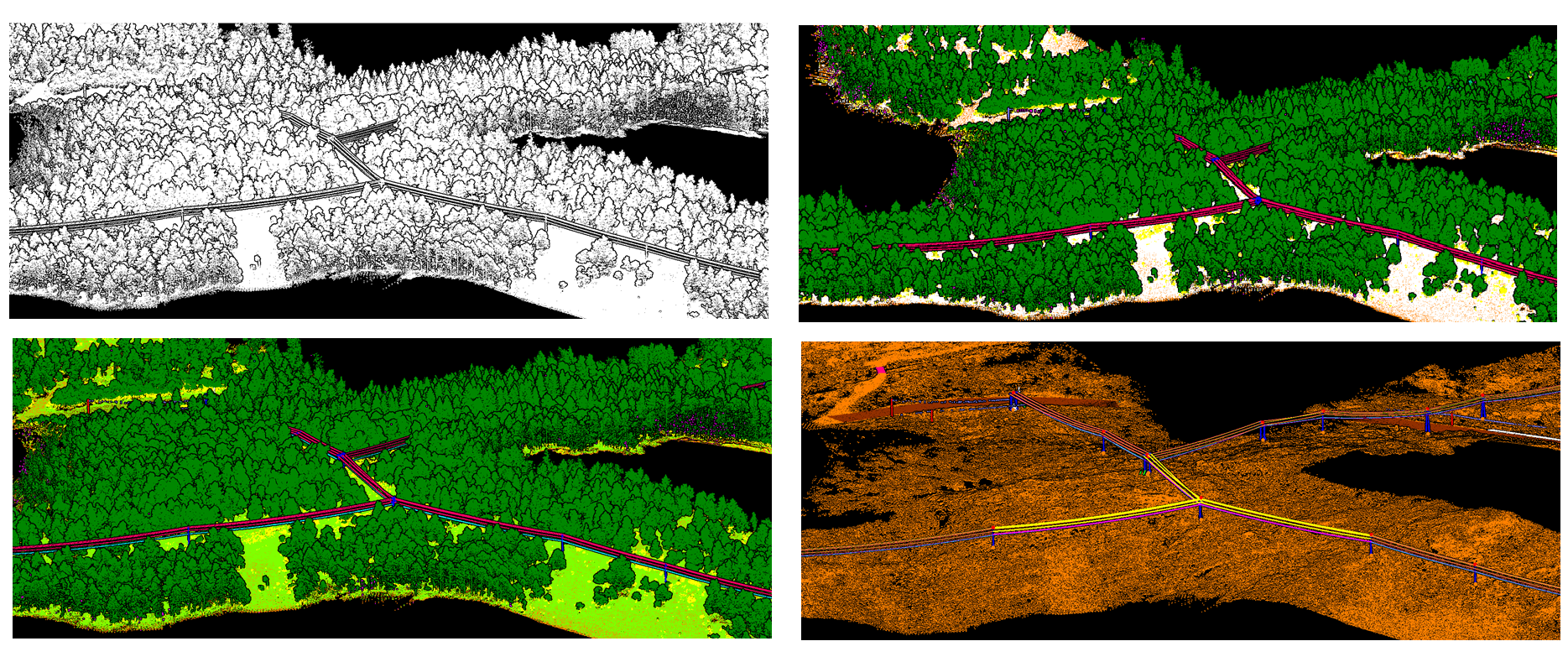
Object territory: Europe.
Average density of scanning: 144,63 points/m2
Performance specifics:
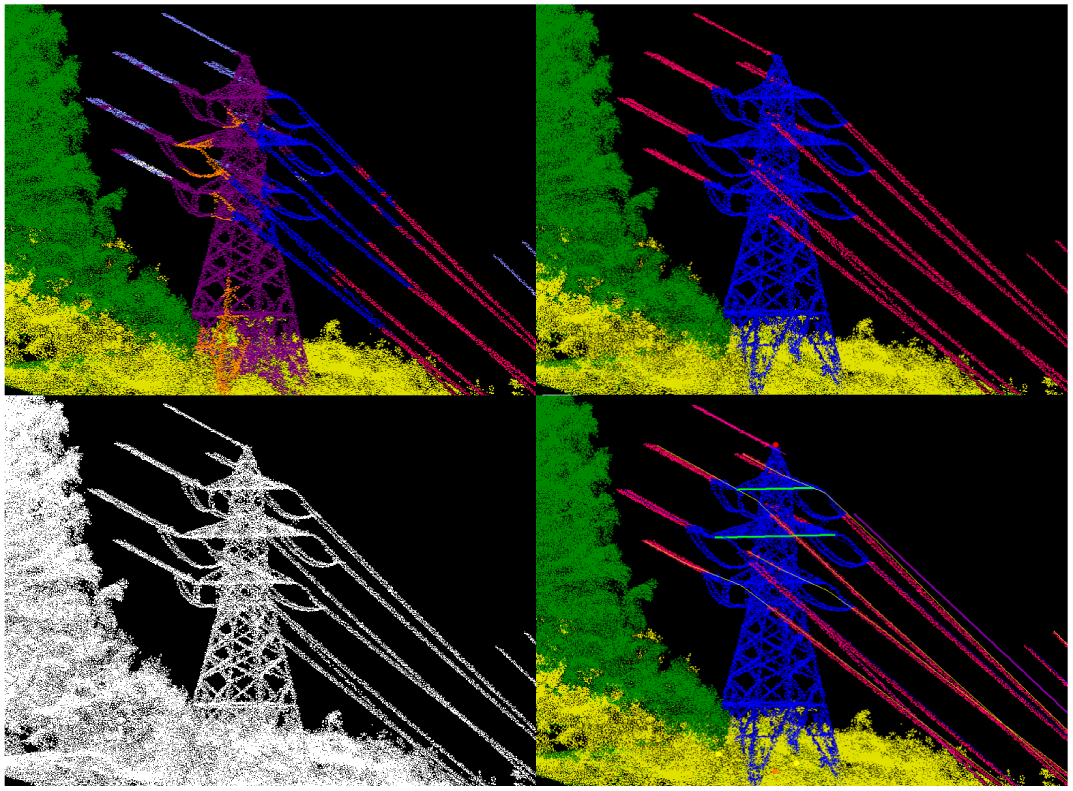
Performance specifics:
- Unclassified
- Ground
- Low vegetation
- Medium vegetation
- High Vegetation
- Buildings
- Low Points / Noise
- Rail
- Road Surface
- Wire Guard
- Wire Conductor
- Transmission Tower
- Guy wires
- Bridge-Deck
- Overhead Structure
- Default
- Other lines
- Other masts
Problem and task.
Is obtaining an accurate DTM, accurate classification of vegetation and power lines, etc.
- Preparing data: smooth points, matching, creating project, dividing into blocks
- Work with DTM. Work with ground and bridges.
- Power lines classification. Other class classification.
- Classification quality check
- Power line mapping and vertex snapping
- Topology quality check
Scope of work: 4000 km.
Time: 4 months.
The main challengethat the client had is budget restriction yet the final data needed to be precise for Vegetation Management.

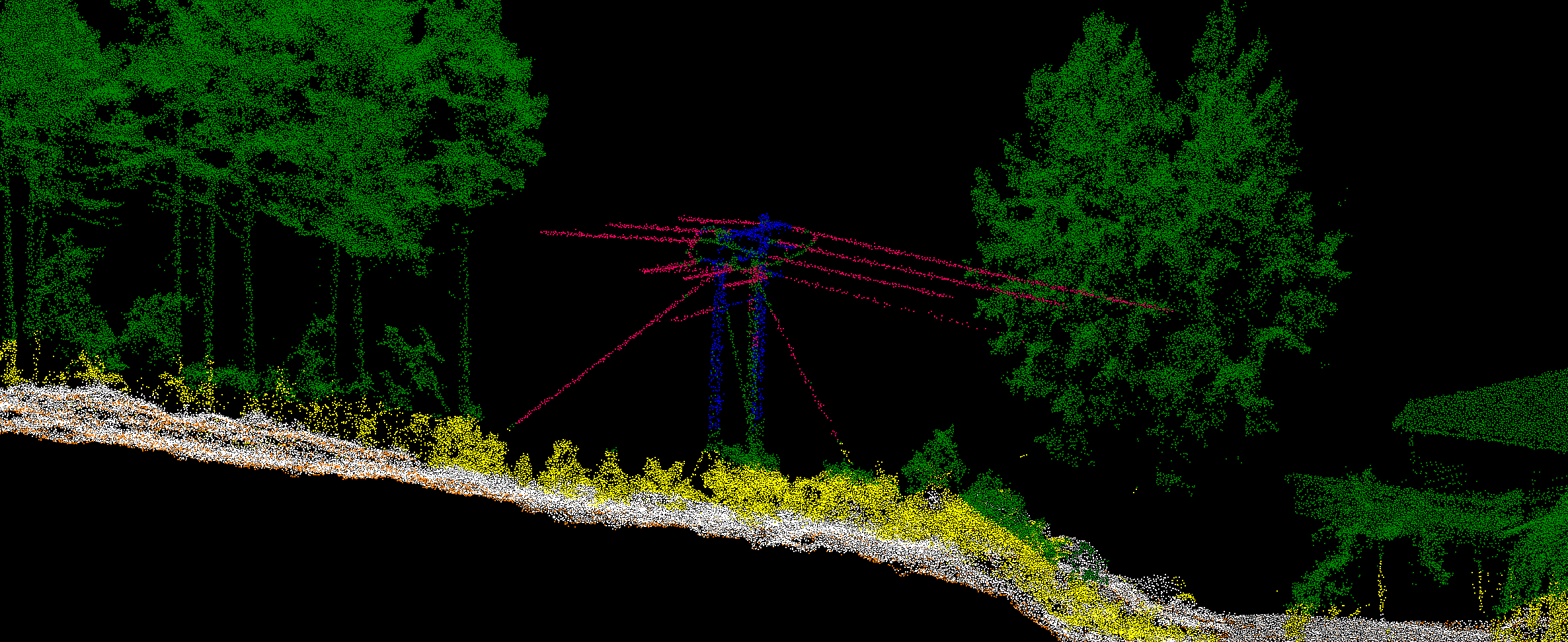

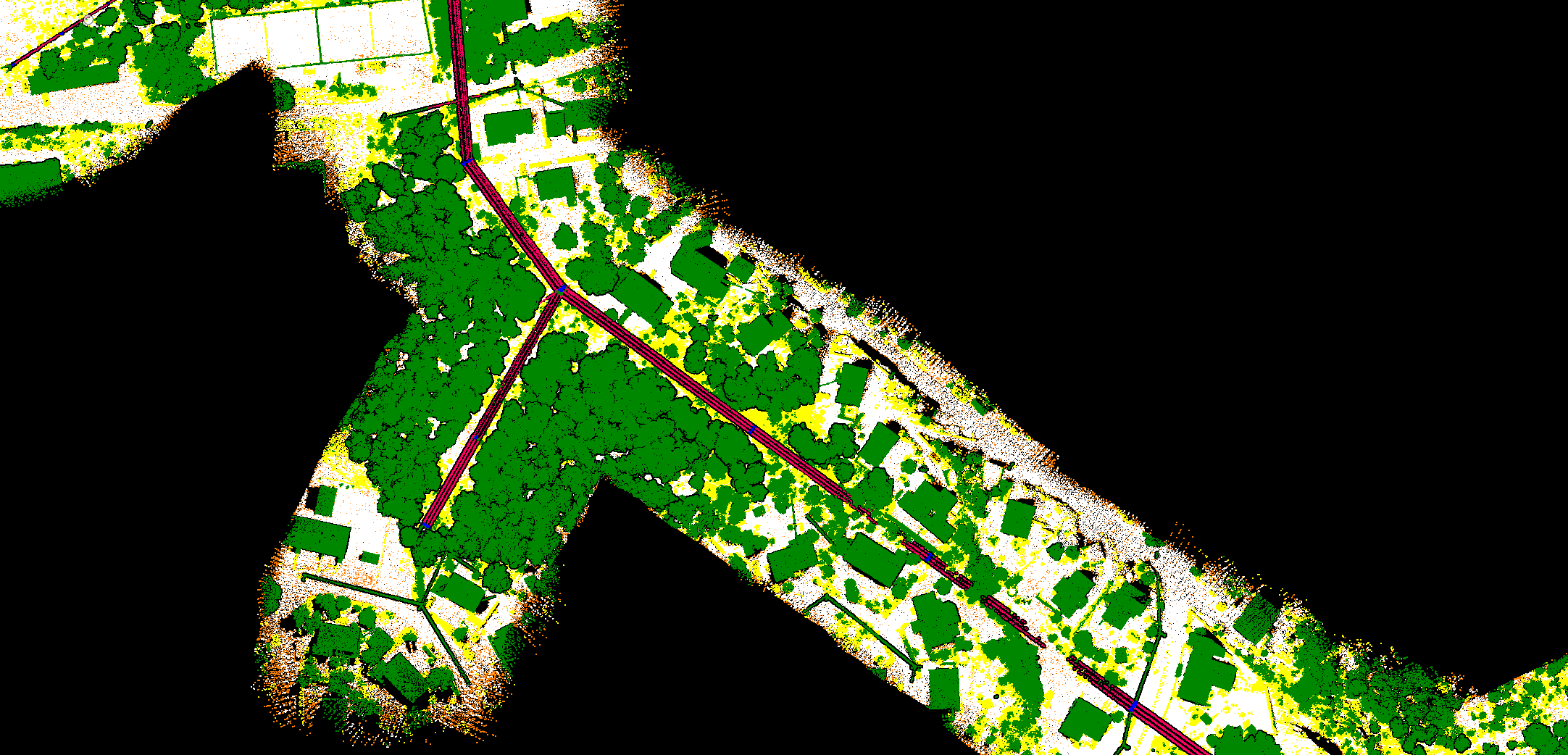


Realization.
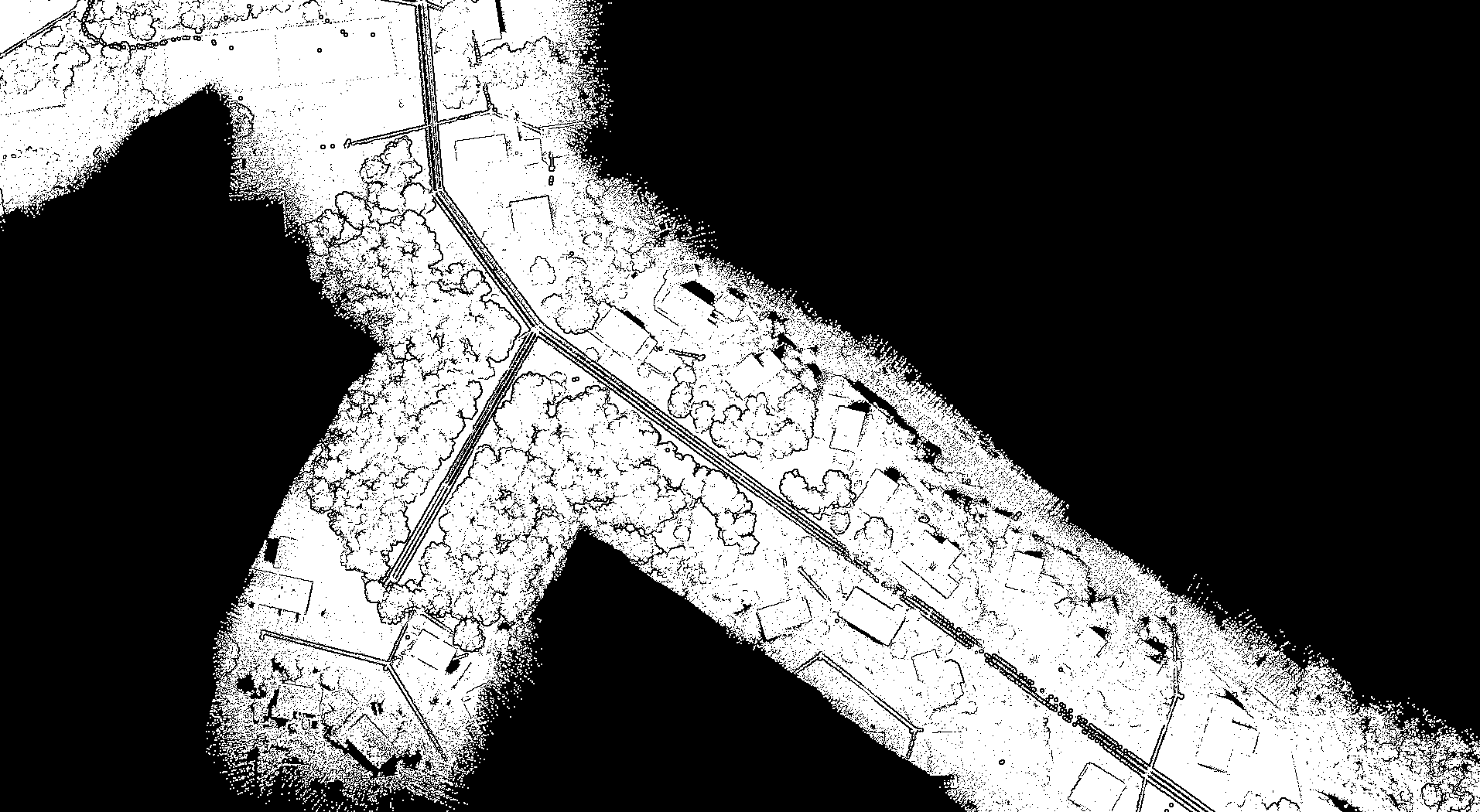
Regarding classification, to accelerate it, we did not classify the earth lines, which were later automatically classified after creating a vector. Because the client provided vector layers for buildings and roads, this greatly expedited the classification process.
Look at our other lidar point cloud classification case study here.
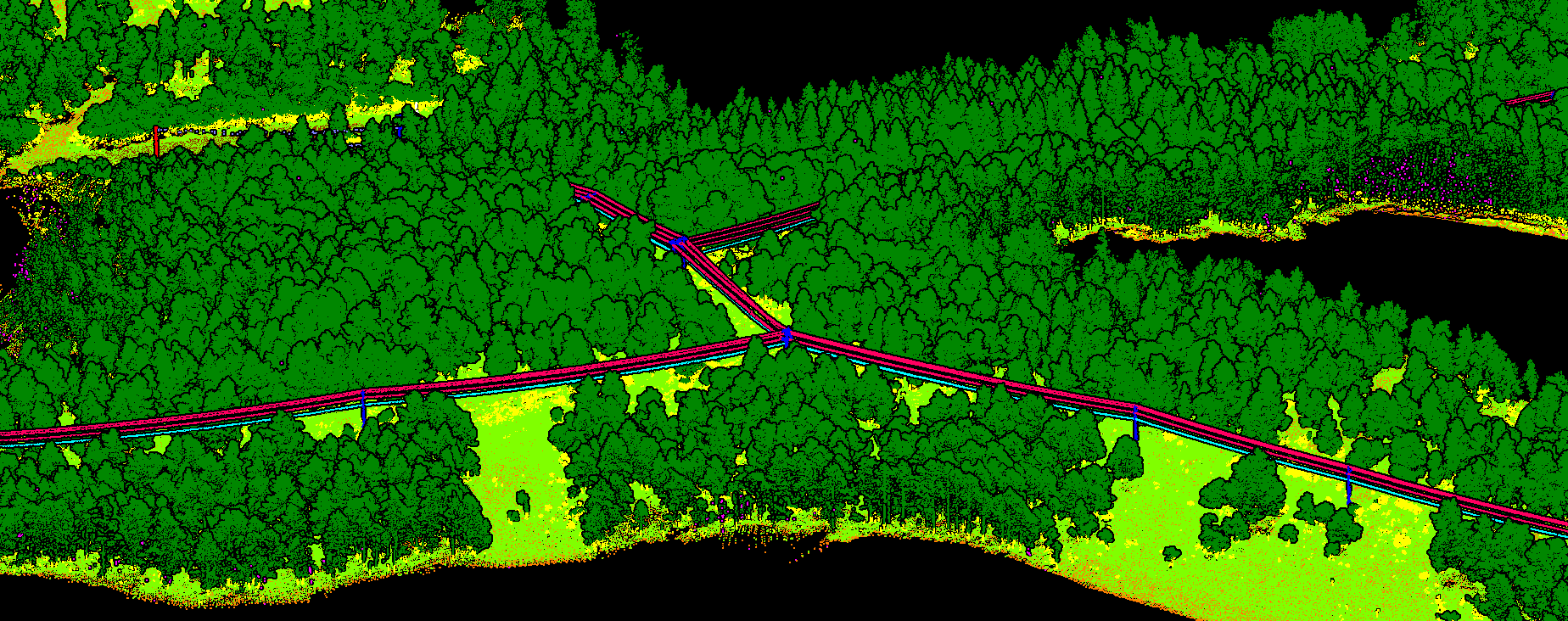

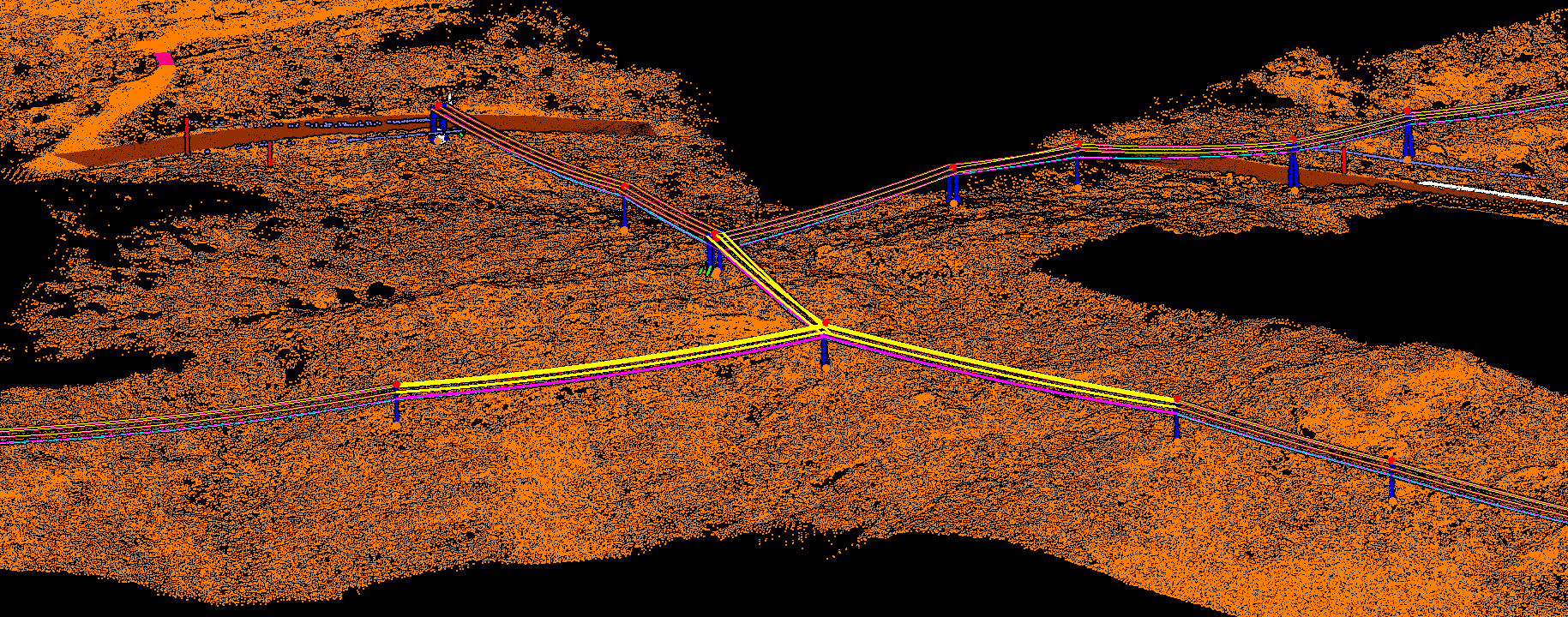

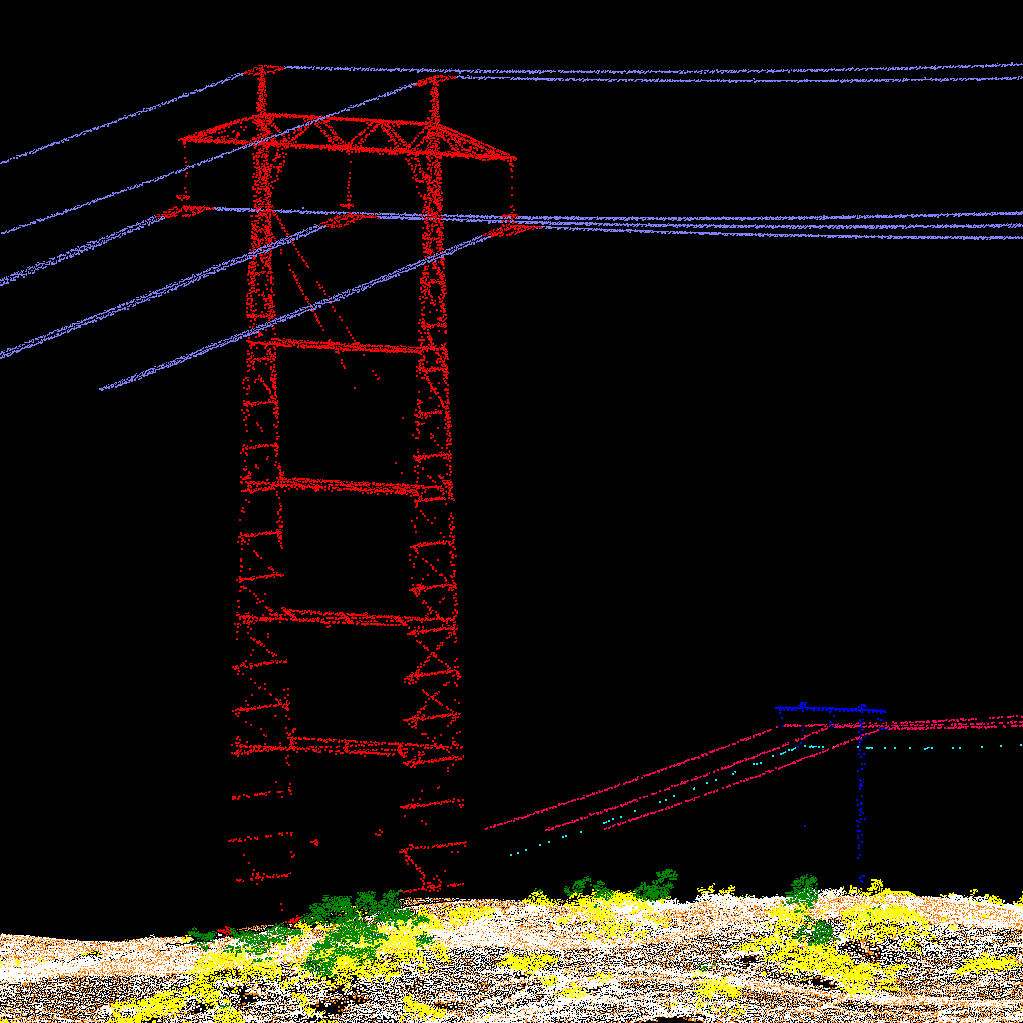
For each transmission tower or mast, a bottom and top point should be marked. However, since medium and high voltage towers differ in their structure, sometimes the point that defines the top of these structures is not attached to the point cloud class of towers or masts, just as the bottom point, which is the foundation of the structure, in most cases will not be tied to the class of towers or masts. We automated this process, by creating an algorithm, which we improved over the course of project completion, and compared results with the manual marking of these points as a separate phase.
We manually created a line, each point of which was the base of a mast. We then transformed these lines into points and dropped them to the ground level. The top point was automatically taken from the snap point of the power lines, which were precisely in the center of the mast and very often at its top point. However, having determined the time for this semi-automatic method and the fully manual one, we found that marking these points manually was 1.5 times faster.
For working with power lines and their extraction from point clouds, we applied a semi-automatic CAD extraction in MicroStation using TerraScan and then our scripts written in Python. An important challenge was snapping all lines by X, Y, and Z coordinates, which we successfully managed. During the process, our script helped optimize the quality mapping process by more than 5 times, compared to manual work. We are currently working on a fully automatic solution for this process. Perhaps by the time you’re reading this case study, our solutions are already executing it completely independently from human intervention with minimal error.

Conclusion.
We can draw a conclusion that by using our in-house developed algorithm that provided semi-automated power line extraction from point clouds and automated 3D line snapping, we managed to save the client’s budget and make the whole process 5 times faster. The data we prepared became an essential foundation for conducting vegetation management. The project’s objective was successfully achieved.
We are currently in the process of developing a Deep Learning Algorithm for automatic power line classification and a fully automated power line extraction algorithm from point clouds.
We have the capacity to process over 1,000 km monthly. We’re continuously open to new projects and opportunities. Please consider sending us a pilot project to evaluate the quality of our services. Don’t hesitate to drop us a message right here.